



How Custody Models Affect Crypto Card Security and Recovery
Custody determines who controls funds, how losses are handled, and what recovery paths exist when crypto cards fail. Understanding custody is essential to evaluating card risk.

Custody as a foundational layer in crypto card infrastructure
Crypto cards sit at the intersection of blockchain-based payment systems and traditional card payment rails. While the card experience mirrors familiar debit or credit card usage, the underlying financial infrastructure differs significantly. Custody determines where digital assets are held, who controls them, and how value moves between on-chain and off-chain systems during payment execution.
In crypto financial infrastructure, custody is not a cosmetic feature. It defines the security boundary of the system. Whether assets are held by a provider, controlled directly by the user, or managed through a hybrid arrangement shapes both day-to-day risk exposure and the available recovery paths when something goes wrong.
What custody means in the context of crypto cards
Custody in crypto cards refers to control over the private keys or signing authority that governs access to digital assets. It does not refer to ownership of the physical or virtual card. A card can be replaced or reissued independently of how assets are stored or authorized.
In practice, custody determines whether a user holds a direct claim on blockchain assets or an account balance maintained within a provider’s internal ledger. This distinction affects how transactions are approved, how settlement occurs, and what remedies exist in the event of loss or misuse.
Custodial crypto card models and asset control
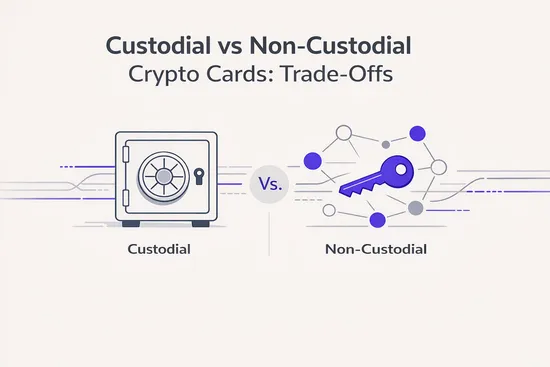
In custodial crypto card models, the provider controls private keys and manages user balances internally. Assets are typically pooled or segmented within provider-controlled wallets, while user balances exist as ledger entries rather than discrete on-chain holdings.
When a card transaction occurs, the provider authorizes the spend off-chain and settles the obligation using its own liquidity and conversion infrastructure. On-chain transactions may occur later for treasury management or reconciliation, but the user does not directly interact with blockchain settlement at the point of payment.
This model mirrors traditional fintech custody structures and enables tight integration with card payment rails. It also concentrates risk at the provider level, since users rely on the provider’s operational controls, solvency, and compliance posture.
Security characteristics of custodial card programs
Custodial crypto card providers implement centralized security measures such as managed key storage, internal transaction monitoring, and fraud detection systems. These controls can reduce exposure to common user-side errors such as lost private keys or accidental approvals.
Centralization also introduces systemic risk. A breach, internal failure, or regulatory intervention can affect all users simultaneously. Individual users cannot isolate themselves from provider-level failures because they do not control the underlying assets directly.
Security outcomes vary widely by provider. Differences exist in wallet architecture, segregation of funds, operational transparency, and jurisdictional oversight. Custodial custody alone does not imply a specific security standard.
Recovery mechanisms in custodial crypto card systems
Custodial custody enables recovery processes that resemble those of traditional payment service providers. Lost cards can usually be disabled and reissued, and compromised credentials can often be reset through identity verification and account controls.
Unauthorized card transactions may be disputed through standard card network procedures. These disputes operate at the card payment rail level and rely on merchant acquiring rules rather than blockchain reversibility.
Recovery is limited to the scope of the provider’s internal ledger. If losses occur outside those systems, such as through insolvency or unresolved internal accounting failures, recovery depends on legal claims rather than technical reversibility.
Limits of custodial recovery and user expectations
Custodial recovery does not mean blockchain transactions can be reversed. Any on-chain movement used for liquidity management or settlement remains final. Providers can adjust internal balances, but they cannot undo blockchain finality.
Users may also face account-level restrictions such as freezes or compliance holds. These controls can protect against fraud but may delay or prevent access to funds during investigations. Recovery timelines vary significantly by jurisdiction and provider policy.
As a result, custodial crypto cards offer familiarity but require trust in institutional processes rather than cryptographic guarantees.
Non-custodial crypto card models and user control
Non-custodial crypto cards preserve user control over digital assets by keeping private keys with the user. The provider does not hold balances and cannot initiate transactions without explicit authorization.
In these models, the card acts as an interface layered on top of a wallet or smart contract. Spending authority is granted through signatures, delegated permissions, or predefined contract rules rather than through account balances held by the provider.
This structure reduces counterparty risk but shifts responsibility to the user. Security depends on wallet hygiene, key storage practices, and the integrity of authorization mechanisms.
Transaction authorization and spending controls
Non-custodial cards often rely on smart contracts, session keys, or spending limits to enable real-time payments. These tools define how much value can be spent and under what conditions approval occurs.
Authorization typically happens on-chain or through cryptographic signing, even if settlement is abstracted away from the user. Once approved, the transaction cannot be reversed by the provider.
Different implementations exist across providers. Some rely on pre-funded contracts, while others initiate just-in-time approvals. These differences affect latency, cost, and risk exposure.
Recovery limitations in non-custodial card systems
Non-custodial custody offers minimal recovery options for asset loss. If private keys are lost, assets cannot be recovered. If a transaction is approved incorrectly, it cannot be undone.
Card replacement restores access to the payment interface but does not restore lost funds. Merchant disputes handled by card networks do not reverse underlying blockchain settlement.
This separation between card rails and on-chain finality often creates mismatched expectations. Non-custodial cards prioritize sovereignty over recoverability.
Hybrid and delegated custody architectures
Hybrid custody models attempt to balance user control with practical recovery options. Common approaches include segregated spending vaults, delegated wallets, or smart contracts with configurable permissions.
In these systems, users may retain ownership of assets while granting limited authority to the card program. Restrictions can include daily spending caps, asset whitelists, or revocable approvals.
Recovery outcomes depend on how authority is structured. Some designs allow revocation or reassignment of permissions, while others rely on multisignature or time-based controls.
Complexity and risk trade-offs in hybrid models
Hybrid systems introduce additional layers of logic and operational dependencies. Smart contracts, off-chain services, and card processors must coordinate correctly for payments to succeed.
These dependencies can create new failure modes. Bugs, misconfigurations, or service outages may block access even when assets remain secure on-chain.
Because there is no standardized hybrid custody model, behavior varies widely by provider. Users and integrators must evaluate documentation and architecture carefully.
Stablecoins and custody-driven recovery dynamics
Stablecoin payments are common in crypto card ecosystems due to predictable pricing and liquidity. Custody of stablecoins follows the same principles as other digital assets but adds issuer-level considerations.
In custodial setups, stablecoin balances are managed internally, and issuer actions such as address freezing can affect recovery outcomes. Users rely on both the provider and the stablecoin issuer.
In non-custodial systems, users interact directly with stablecoin contracts. This preserves control but also exposes users to protocol-level constraints and enforcement mechanisms.
Custody versus other layers of crypto payment risk
Custody is only one component of crypto payment infrastructure. Card program managers, payment processors, liquidity providers, and compliance systems all influence availability and recovery.
An outage or regulatory action at any layer can disrupt payments regardless of custody model. Custody determines asset control but does not guarantee uninterrupted service.
Evaluating crypto cards therefore requires a layered perspective that separates custody risk from operational, regulatory, and settlement risks.
Practical implications for security and recovery expectations
Custody choices shape how losses are handled, who bears responsibility, and what recovery paths exist. Custodial models emphasize managed security and institutional recovery. Non-custodial models emphasize control and finality.
No custody model eliminates risk. Each reflects trade-offs between autonomy, usability, and recourse. Understanding these trade-offs is essential for realistic expectations.
In crypto payments ecosystems, custody is not a guarantee of safety or recovery. It is a design choice that defines where control resides and how failures are resolved in practice.