


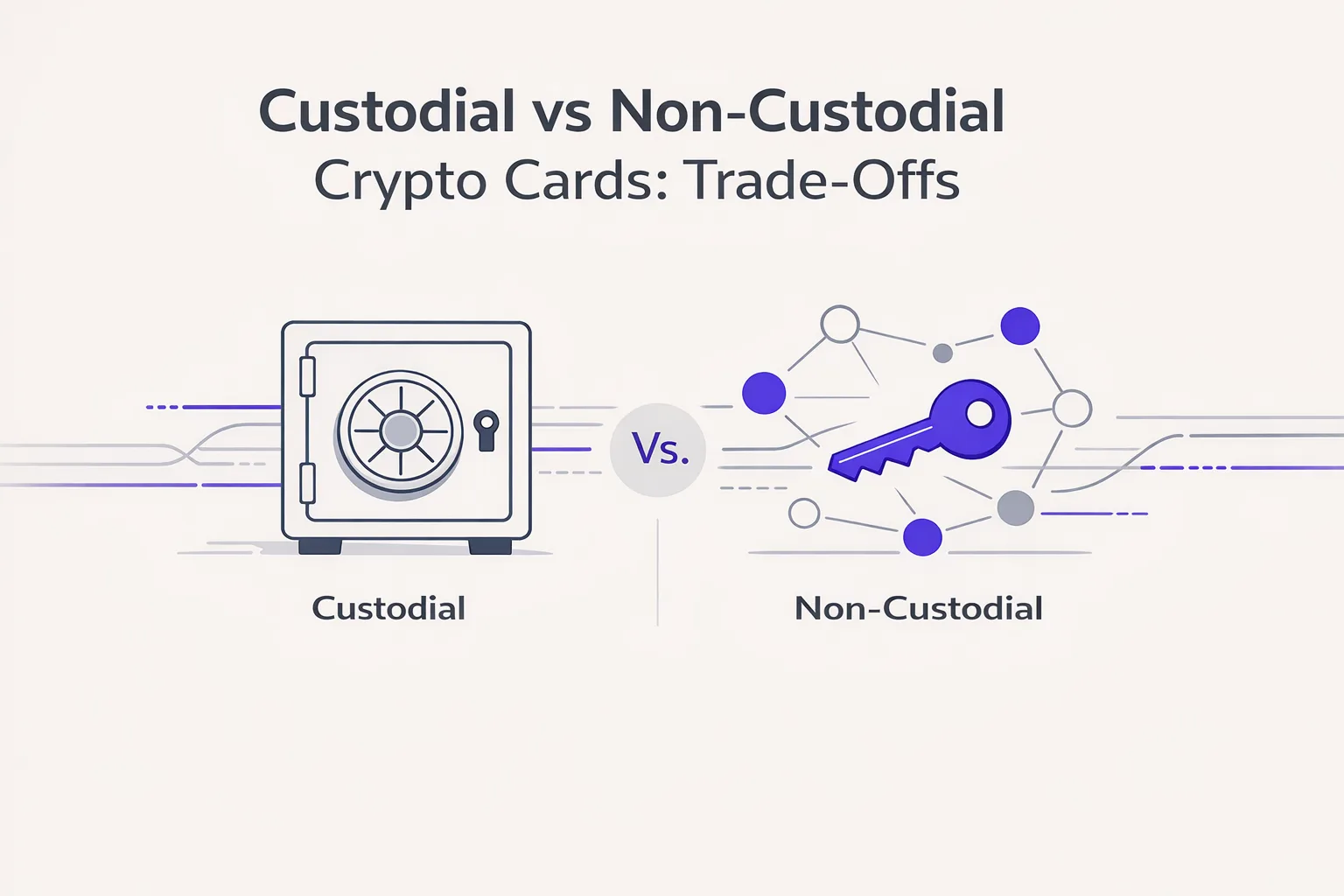
Custodial vs Non-Custodial Crypto Cards: Practical Trade-Offs
Custody design changes where balances live, who controls keys, and how card purchases are authorized and settled. This guide explains practical implications for users and payment infrastructure.

Why custody design matters for card payments
“Custodial” and “non-custodial” describe who controls the private keys and operational access to the assets that fund a crypto card transaction. In practice, custody design affects how balances are held, how transactions are authorized, what happens during outages, and which parties are responsible for compliance and dispute handling.
Crypto cards typically run on traditional card payment rails at the point of sale, while the funding side uses a wallet, an exchange account, or a stablecoin balance that is debited in the background. Because the merchant receives a card payment, custody choices mostly change the upstream flow: where funds are sourced, when conversion occurs, and which entity can freeze or move balances.
How a typical crypto card transaction settles
At checkout, the merchant submits an authorization request through the card network, and the card program decides whether to approve it based on available funds and risk controls. This looks similar to any debit or prepaid card authorization, even if the end user thinks in terms of crypto balances.
After authorization, settlement and clearing occur on card rails, and the program must cover the fiat settlement obligation to the merchant’s acquirer. The crypto or stablecoin side is usually an internal funding mechanism that ensures the program can meet that fiat obligation, either by holding fiat liquidity, converting digital assets, or maintaining stablecoin liquidity that can be off-ramped.
Where conversion happens varies by provider and program design. Some models convert at authorization time to reduce volatility exposure, while others convert at settlement or fund from a pre-converted fiat or stablecoin balance; the details differ across custodial and non-custodial approaches and can differ even among providers using similar labels.
Custodial crypto cards in practice
With a custodial crypto card (also known as self-custodial), the user’s spending balance is typically held in an account controlled by a provider, such as an exchange, a custodial wallet provider, or a card program partner. The provider maintains the ledger, controls withdrawals, and can often support instant internal transfers because balances are tracked off-chain.
Custodial designs can simplify card funding because the provider can manage liquidity centrally, net transactions across users, and execute conversions internally. This often enables faster authorizations and a smoother experience when moving between crypto, stablecoins, and fiat, because the provider has direct control over the balances used to cover card rail obligations.
The main trade-off is counterparty and operational dependency. The provider can impose freezes, withdrawal holds, or account restrictions based on compliance, risk controls, or platform outages, and users rely on the provider’s custody, security model, and solvency to access funds.
Non-custodial crypto cards in practice
With a non-custodial crypto card, the user typically controls the wallet keys, and spending is enabled through a mechanism that can access funds without the provider holding the user’s assets as a custodian. Implementations vary, including smart contract vaults, delegated spending permissions, or structures that create spendable balances derived from user-controlled funds.
Non-custodial designs can reduce reliance on a centralized custodian for holding assets, but they introduce new operational constraints. Funding may require on-chain transactions, approvals, or signature flows, and settlement assurance still has to be met for card rails, which often leads to buffers, prefunding, or limits that protect the program from reversal and liquidity risk.
Non-custodial does not eliminate the role of intermediaries in card payments. Even if the wallet is user-controlled, the card issuer, program manager, and network rules still govern authorization, risk checks, and dispute processes, and providers may still restrict card access based on regulatory requirements or fraud controls.
Stablecoins as the common bridge
Many crypto card programs rely on stablecoin balances as a pragmatic funding layer because stablecoins reduce price volatility and can simplify treasury operations. A stablecoin card flow can either keep the user in stablecoins until a fiat off-ramp event or maintain fiat liquidity while using stablecoins for internal settlement and reconciliation.
Custodial models often keep stablecoins in omnibus wallets or internal ledgers, enabling rapid movement between stablecoin balances and fiat settlement accounts. Non-custodial models may use stablecoins in user-controlled wallets but still require a reliable way to convert or bridge to fiat settlement, which can introduce timing and fee considerations on-chain and off-chain.
Fees, FX, and the hidden cost centers
Crypto card cost drivers commonly include asset conversion spreads, network fees when on-chain transactions are required, and card program costs like interchange, scheme fees, and chargeback handling. The user-visible fee schedule may not fully reflect conversion and treasury costs embedded in exchange rates or execution timing.
Custodial models can sometimes internalize conversions and net flows, which may reduce on-chain fees but can increase dependence on the provider’s pricing and execution policies. Non-custodial models may expose users to more explicit on-chain costs and timing, especially when funding requires blockchain transactions or when liquidity routing is not fully abstracted.
FX adds another layer because card transactions settle in fiat currencies and stablecoins are often denominated in USD or EUR equivalents, depending on the program. Providers vary in how they apply FX rates, when they lock them, and whether they pass through third-party rates or apply their own pricing.
Compliance, controls, and account availability
Card programs operate within regulated payment ecosystems, so KYC requirements, sanctions screening, and transaction monitoring are common regardless of custody model. The practical difference is which entity performs which control and how quickly restrictions can be applied, since custodial providers can directly control balances while non-custodial designs may rely on limiting card access rather than seizing funds.
Availability by country often depends on issuer licensing, program sponsorship arrangements, and local rules for e-money, prepaid, or card issuing. Because these constraints sit at the card-rail layer, a non-custodial label does not guarantee broad geographic coverage, and a custodial label does not necessarily imply limited access; providers differ materially.
Risk and failure modes you can plan around
Custodial cards concentrate risk in the custodian and its operational stack, including platform outages, withdrawal limits, and centralized account actions. Users benefit from a more abstracted experience but accept that the provider can become a single point of failure.
Non-custodial cards shift some responsibility to the user and to smart contract or wallet tooling, including key management risk and on-chain transaction reliability. Users may gain clearer control over funds, but the card experience can still degrade if the provider cannot guarantee liquidity, if on-chain congestion increases costs, or if the card program applies tighter limits to manage settlement risk.
Choosing a model for a given use case
Custodial cards often fit scenarios where users prioritize simplicity, rapid conversions, and unified balances across services that also offer trading or off-ramps. Non-custodial cards often fit scenarios where users prioritize self-custody principles and are comfortable with wallet operations, approval flows, and the possibility of tighter spending constraints.
In a directory context, it helps to evaluate cards by concrete attributes rather than labels alone. Look for custody type, supported assets and stablecoins, supported countries, settlement and conversion mechanics, fee disclosures, KYC requirements, and whether funding depends on on-chain transactions, because provider implementations differ even within the same category.